Tuesday, December 14, 2010

Winning at Tic Tac Toe

Who hasn’t played Tic Tac Toe? You may know it by different names, like naughts and crosses or X-zero, but you are certain to have played it in your childhood. You would have progressed in the game to a stage where it was difficult for someone to beat you and any game with a good player always resulted in a draw. You figured that this is a very simple game and moved on to other things in life.


But have you thought about what is a foolproof formula to win in this game? Or at the very least increase your chances of a win against an inexperienced player, since it is not possible to beat a good player? If you think about it, it’s actually very interesting to figure out the move sequences in this game. Let’s try to analyze the first few moves.

But first, the rules. The game consists of drawing a grid of 3 x 3 squares like this.


The players take turns to play. The first player puts an ‘X’ in one of the nine squares. The next player puts a ‘O’. Back to the first player who puts an ‘X’ and so on, till any one player gets three of his pieces (X or O) in a row, vertically, horizontally or diagonally to win. In case no one succeeds in doing that, it’s a draw.

A typical game when finished would look like this – in this case X has just won:


The strategy is of course to complete the row of three once you have two in a row; if you don’t have two in a row waiting, you block your opponent if he has two in a row; if that is not the case, you see if you can create a situation where you place your move in such a way that you create two opportunities of a finish, in other words create a fork, which makes the opponent helpless. What I mean by a fork is this:


X has created a situation where he will win in the next move.

The first move that X makes can be one of three types:

Centre opening: Where X places his move in the centre square, like this:


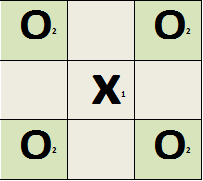
Corner opening: Where X places his move in one of the four diagonal corners, like this:


Side opening: where X places his move in one of the side squares, like this:


Let’s analyze each of these openings one by one.

Centre opening: If X opens in the Centre, O has to place his move in one of the diagonals, else he loses.

Correct reply:


If O places his move on the side, this is what happens:


X wins

Corner Opening: If X places his move in the diagonal corner, O has only one possible move, and that is, the centre. This is what happens if he plays any other way, e.g.,
Possibility 1: If O replies with one of the sides:


Possibility 2: If O replies with one of the corners:


X wins in both cases.

Side opening: If X opens on the side, O can play one of the following four moves:


i.e. O can place his move to either side of, or in any of the two squares above, X.

If he doesn’t, this is what happens:

Case 1:


Case 2:


X wins in both cases.

I shall not analyze the moves following these. That should be easy enough for you to do!

Monday, December 13, 2010

Deepika Padukone on Relationships

This is what happens when you go and ask a film star for her philosophy on life!


 Excerpts from an interview with Deepika Padukone (by Sneha Mahadevan – DNA dated 12 December, 2010).


All bold-faced items are extracts from the article in DNA – rest of the comments are mine.


Deepika says that in real life she is quite conservative in her thoughts about love and relationships. "If I am in a relationship, I give it my 200%. Maybe it is because of my upbringing or because I have seen my parents have a successful marriage. .. I am made to believe that marriage and relationships are for keeps… eventually you work it out if it matter to you… if it doesn't, then you move on amicably"


The new definition of loyalty apparently has to do with being loyal for the moment. "When I am with my boyfriend for the night, the one-night stand, and only the one-night stand, occupies my mind, my thoughts, and my body. I believe in being 300% loyal to him. This is because of the inspiration I got from my pastor at Church who used to tell us that Relationships are for keeps" – unknown starlet being quoted in Hollywood Tribune!   I am sure variants of that quote are being published all over the world at the moment.  Hail conservatism!


"When a relationship ends, you have time for yourself. It also makes you realize the importance of certain other relationships in life, which you tend to sort of neglect when you have a special someone. It has taught me never to take anyone for granted"


All the "others" in her life, who are not her special someones, are very lucky. She is likely to realize their importance time and again!


Though work helped her get over a break-up (with Ranbir Kapoor), Deepika suggests other ways to deal with a break-up too "You could get drunk, go out partying or maybe get a new haircut."


Lovely suggestion. If you see her bald suddenly, you know she is going through a particularly intense break-up.


Certain relationships help you develop and grow as a person. I have been single and I have been in relationships, both have their plus and minus points and I am quite okay with both. The best part about being single is that you are not answerable to anybody. When you are in a relationship there are certain responsibilities.


So when you get tired of your responsibilities, you should go and be single again? This is too complex for me. You can either like one or the other – actually, I am still trying to figure this one out. Deepika is too deep for me!


"I think one of the reasons why relationships don't survive is because you are constantly in touch. There is no time to miss that special someone. Earlier people had to travel miles to make a phone call or write a letter and that is probably what kept the relationship going"


Wow. She is the one who wants to give 200% isn't she? I am sure her boyfriend (don't know if that's the right politically correct word – should we use "relator" and "relatee"?) would have had no objections if she did not insist on calling him fifteen times a day or Videocon ten times a day.


I am still trying to digest it. Rajneesh or J Krishnamurthy are far easier to understand!


Friday, December 10, 2010

Asset Allocation revisited

This whole business of "asset allocation" has been overhyped. As per conventional theory which all financial planners like to quote, "it has been shown that 80% of your return depends on asset allocation (between debt, equity, etc.) and only the balance on individual skill, luck, timing, or whatever".  So you should invest in a disciplined way x% in equity, y% in debt, etc. 


The asset allocation theory is being stretched to say things like "x% in local equity, y% in debt, z% in emerging market equity, a% in commodities" – basically, don't put all your eggs in one basket. But how do you determine those percentages? Don't believe any numbers that are thrown at you from so-called sophisticated financial analysis. Most of the analysis rests on the fundamental premise that the different asset classes have a low or negative correlation. The way asset prices move up and down nowadays, they all move up or down at the same time, thus destroying the fundamental premise itself.


The problem with all such "automatic" algorithms is that they are based on assumptions that are forgotten later - and the rule is blindly followed. There can be no one rule. Investment is opportunism, and strategies will have to keep adapting with changed circumstances.


One more rule "As you grow older invest less in equity, and more in debt. Follow the 100-age rule to decide the percentage you will invest in equity."


The performance of equity markets is tracked by looking at the "index". The Index is just a bunch of selected stocks with assigned weights out of a universe which consists of hundreds of stocks. Hence the performance of the index is no indicator of the performance of any individual scrip, especially a stock that is not part of the index. However, all stocks tend to move along with the index (the beta) apart from moving on their own due to "intrinsic" (alpha) factors. The fact that the movement of the index usually is a good proxy for movement of individual stocks just shows that factors which move the market play a very important role in the performance of your portfolio, apart from your individual scrip.


You are supposed to ignore these dips and rises in the index and keep investing the same percentage in a disciplined way, as per the asset allocation school of thought. They are right in a sense if you consider the fact that most people buy when the markets have already trended up, and sell when it's down. Any non-thinking approach, read disciplined approach, will give better returns than that.


January 2008: 21,000. October 2008: 9000. December 2010: 20,000.


If you had bought at the highs and sold at the lows, you are screwed.  The disciplined approach is better. But with such volatility, can we afford to ignore the market movements?


Take today's levels. Given the macroeconomic factors (of the world economy!) we do not know how money flows will happen. If money is pulled out of India, the markets will fall. If a lot more money comes in, they will rise, but making the situation even more ripe for a steeper fall. I would probably reduce my exposure to equities right now.


No asset allocation theory takes real estate into account. Real estate will throw all your theories off by miles. It needs lumpy sums of money, and probably a loan as well. So in effect, say when you buy your first house, you are invested in real estate more than 100% of your net worth! Then you repay you loan over a period of time, save some more money whether in equity or debt, and then when you buy your next property – you are back to more than 100% in real estate since you have another loan! It does not make sense to keep fixed deposits or debt investments on the one side, and a loan at a higher rate of interest (which it invariably is) on the other. So what asset allocation are we talking about?


Theory urges us to keep more and more money in debt as we grow older. When you are around 50, keep at least half your portfolio in debt. That yields you 8%, and net of tax 6%. Inflation is running at 7% levels – or let's assume what you get just covers inflation. How can you become wealthy following this approach?


Life expectancy has increased. Job expectancy has decreased. Let us say you stop working at 55, due to factors voluntary or involuntary, and you have 70% of your money in debt. You are going to live till 100 (God bless you!) – pray, how are you going to manage?


In the US currently, debt is yielding a return of zero point zero something percent. So they are drawing down on their principal to meet living expenses? And their life expectancy is high…


Then what do we need to do?  Which investment gives us  very good potential for upside while minimizing the downside? Real estate, as in land. Buy small plots in places which are going to see population growth or development. It could be suburbs of large cities or in tier 2 towns about 5 to 8 km from the city centre – in other words, the periphery where development has not yet caught up but will catch up soon. At worst, you will get back your principal and inflation over the next ten years. At best, if you choose well, the upside is, Inshallah, unlimited.


Choose small plots within developments where "conversion" has just happened, where the builder has bought the land very cheaply on a "per acre" basis, converted it, laid out the basic amenities, and sold it to you at a good premium. Let us not grudge him that premium since buying land by the acre and taking care of it is not within our range of capabilities. When it is part of a "development" the security aspect is also taken care of.


Once you buy that land, forget about it. Don't forget to pay the annual property tax though.


When you retire, sell a couple of these plots, and use the money to build on a couple of others, and rent them out for a steady income stream.


If you have identified some good companies which have great growth potential, buy equity directly in those. That's for individual scrips.  For the broad market, when the markets are at a low (who knows what is low– let's say when you think so) buy index etf's.


Borrow to the extent that income streams, including rentals, can support, especially to buy real estate. There is always the threat of hyper-inflation all over the world, given the way governments are running the printing presses. If that happens, it is better to be a net borrower rather than a net lender. It is also good to have your money in "real" assets like real estate and gold/silver.


That reminds me – don't forget to put some money aside in gold and silver!


(What I have said here is not conventional theory, and it is not something everyone will agree with. I welcome your views, reactions, rejoinders, denouncements… )


Thursday, December 9, 2010

There is no free lunch

Assured return equity plans. ULIP's that guarantee a minimum return. Structured products with guarantee of highest NAV. Capital protection schemes. All kinds of twists are added by sellers of financial products to convince the customer that he can have the cake and eat it too. Everyone wants to make super-profits but does not want to take the risk of losing his money.


Debt instruments offer capital protection. We are of course ignoring counter-party risk here. They are priced at 7 to 9 percent (currently) for durations of one-year plus. By definition anything that offers more in terms of returns comes with higher risk attached.


Equity has given historical long-term returns in the range of 15% plus. Actually, equity is very controversial – depending on which "long term" period you take and the range of years you choose, the returns can vary widely. But let's say for the sake of simplicity that the ten-year returns from 2000 to 2010 is, say, 15%; and if you see three-year blocks in the same period, the returns vary from minus 50 to plus 150 percent. (Please do not rush to confirm data – this is just an example though I think it should be fairly representative).


As a customer what do you want? You want equity-like returns of 15% plus. But you want your capital to be always protected. As a fund manager you know that this is not possible. But the marketing guys are pushing you. The CEO has set the year-end targets for net fund inflows. Competitors are offering products that promise the moon. So you succumb – we all do, ultimately.


UTI's  was one of the earliest  and most famous case of guaranteed returns going awry. It had to be split into two, and wait for divine providence in the form of a market resurgence to breathe some life back into it. In the meanwhile, the people who had invested were not really concerned; the Government of India backed it anyway.


How can a fund manager offer a guaranteed return on any mutual fund or a basket of investments that resembles a mutual fund? Several ULIP's offer this, even if at a low number. Guarantees are only possible when the fund manager invests a portion of his portfolio in debt products. If the minimum guarantee is, say, 6%, the fund manager can just invest most of his corpus in debt and meet his target. That is what he will do. But what is portrayed to the investor is different.  The investor is under the impression that it is predominantly equity that his money is kept in.


What about the Highest NAV guarantee? In this fifteen-year product we will guarantee you the highest NAV of the next ten years, or your original principal back, at the end of the fifteenth year. Capital protection, along with getting the highest NAV! Manna from heaven!


What happens of course, is that as the stock market goes up beyond a point, the fund manager shifts more and more of the money into debt so that at maturity, the promises can be met. He might even hedge himself at various points in time. So finally your returns even out and you pay an additional cost for all this hedging as well as for the fancy name of the scheme. There is of course a small probability that markets might not trade in the bands expected, and then things can go horribly wrong. In this case, if the markets move only in the upward direction, the fund manager is in a bit of trouble.


Then there are complicated structured products. If the index, which is today at 20,000 goes up to 26,000 levels, you get the full benefit, after that you get half of the increase till 30,000; after that, nothing. On the downside, you are limited to going down till 16000, a twenty percent drop. There can be infinite variations of these. There must be complex hedging algorithms at the back end to take care of eventualities with assigned probabilities to each.


From the customer's side, he gets some "assurances" but at what cost? Finally, the fund manager has to invest in the same equity and debt markets, and their fundamental characteristics do not change. For hedging against any eventuality, the fund manager (a) takes a call on the direction of the underlying, and (b) pays a price if the call goes the other way. It is not possible for the fund manager to cover against all eventualities; hence by necessity he concludes that certain events are so improbable, that he can risk not covering against them. How many of us have not taken life cover because we are sure that nothing will happen to us?


As people have experienced across the ages, there is no such thing as an absolute guarantee. Nassim Nicholas Taleb gave it a very catchy name, he called it "The Black Swan". In his rambling style, he told us that there are no guarantees in life. Just because you have not seen a Black Swan in your entire life, does not mean that they do not exist. We all know that of course. But we want to believe – how we desperately want to believe! There are no black swans, there never will be, if I see one it's my eyes that are deceiving me – it's not black, or some sorcerer has colored the feathers, it's not black… human beings have an inherent need to be  comforted with false assurances so that the castles they have built in their dreams do not come crashing down.


Mathematical models give a false sense of security. You pop in some numbers into an options pricing model, which goes by the intimidating  name of Black Sholes and generate some numbers to assess your liability; or aggregate sub-prime loans into a Markowitz model which miraculously get converted into Triple A gilt-equivalents; feed some cricket scores into a black box called Duckworth-Lewis and decide the fate of the World Cup; all the while with a secret fear which you do not acknowledge, that you don't understand what the models do, overridden by a foolish hope born of wanting to believe that nothing will go wrong. The priest who guards the temple in each case assures you that God will answer  your prayers, everything will be fine, he understands how God's mind works, he will tell you what rituals to follow to stave off doom, and charges you for it. Why does high Finance seem very similar to religion? The parallel to religion does not end there. When disaster strikes as it should (make that "as it will"), the whimsical ways of God (six sigma events) are blamed. And placatory rituals are found. Sometimes the old religion is abandoned, only in search of a newer, more complex, model.


No one knows how these models work, and no one wants to. In any case even if they understood it no one has the patience to listen to them explaining it. How many times have you seen cricket commentators explain the logic of what Duckwort-Lewis throws up? Which of us knows what were the assumptions that went into the model in the first place?  Which one of us really wants to know?


If a simple cricket game with its limited variables can be so intimidating, what about the real world. How many variables do an economy move?


As a customer if the Government of India or an institution backed by it offers me a guaranteed product, or the Tatas, or Birlas, I just go for it. If something goes wrong, Big Daddy will pay. I know that there is no free lunch, but my lunch will be paid for by someone else.


The latest case of course being the horrible losses incurred at Aditya Birla Money on the Options Maxima Scheme. The "Short Strangle" strategy based on the premise that markets would be range-bound went horribly wrong. Big Daddy Kumaramangalam had to chip in with a 100 crore infusion from Aditya Birla Nuvo.


Someone finally has to pay for the lunch.

Tuesday, December 7, 2010

Microfinance - Part 1

Everything is for helping the poor. As is Microfinance. The story goes like this.  The poor farmer whose wife is having a complication during child birth rushes to the money lender to borrow to save her life. Or to get his daughter married. Then ends up working for the rest of his life just to keep up with the interest payments. If it were a Hindi film, the moneylender would probably be having malicious designs on the wife or daughter. It's enough to make you weep.


A lot of it is true as well. However, moneylenders do perform a useful function, that of lending money to the poor in times of need, especially to those who are outside the pale of formal banking systems and who do not have any security to offer.


The obvious question then arises "Why cannot  banks offer microfinance – finance in very small amounts, to the poor?" The banks cannot do it – they do not have the reach and their cost of servicing loans is very high due to high salary and overheads. They would rather make 10,000 loans of Rs. 10 lakh each than 10 lakh loans of Rs. 10,000 each. They also do not have the mechanism to make collections on a weekly basis at the customer's doorstep – most of the beneficiaries would be people earning daily wages who will find it impossible to save up to pay once in a month.


However, there is a huge arbitrage here which cannot be ignored. The lending rates of banks are in the range of 12 to 18 percent, while the lending rates of moneylenders  could vary anywhere upwards of 60 percent, and in several cases even exceed  100 percent per annum. This was a big opportunity for an institution or institutions to step in to bridge the gap. If the institution could manage to borrow from banks or from entities abroad at 12 percent levels and lend it out at, say, 25 percent levels… that is what is called an untapped opportunity in entrepreneurial parlance. Such a model to be successful would need to have the following:

                Low-cost disbursal and collection mechanism

                Ensuring no defaults – a real challenge when the borrowers are small and numerous

                Scale in terms of sheer number of loans


Grameen Bank of Bangladesh has a tried and tested model which has been extremely successful in that country. They lend to the poor who do not have any collateral and ensure repayment through groups formed at the local level. Peer pressure is used to ensure that people pay – the group is also useful in inculcating good savings habits and spreading financial literacy among the people. The Grameen Bank works primarily for upliftment of the rural poor; its lending rates are in the region of 20 percent. The bank has been in existence for more than 25 years now. It acquired international recognition when it was awarded the Nobel Peace Prize, along with its founder Mohammad Yunus, in 2006.


In the last few years, several microfinance institutions set up and started expanding in India following the "Self Help Group" model. The Group is held responsible for timely repayments, and systems are institutionalized where they meet regularly. The Group this ensures repayments through peer pressure. Some of these institutions grew really big. The one that is in the news recently, SKS Microfinance, founded by Vikram Akula, is the biggest, with millions of borrowers across India.


As they began and started expanding, the repayment record of these institutions was very good. They boasted of loan repayment rates of 99% or above. How much of this is due to evergreening of loans (the practice of lending fresh money to repay the old dues) is not clear; there is reason to believe that at least in the initial years when the whole movement took off, the rates of repayment were genuinely high, but 99% repayment from poor borrowers is something that stretches credulity.


The story for the consumption of the general public was that these institutions were doing a lot of social good. They were lending at rates far lower than the money lenders – this is like saying that you are celibate since you sleep around less than Tiger Woods – and aiding in social development by "enabling" the poor. Enablement implied that they could use the money to start their own business or stand on their own feet, or avoid a debt trap – actually it's a bit vague what it meant.  A couple of microfinance institutions realized that true enablement occurs due to a combination of factors that includes access to education, easy access to health care facilities, availability of power and infrastructure, etc.; money needs avenues to be deployed productively and the ecosystem that creates those avenues needs to be built up first.  These few institutions realized that focusing on rural development initiatives along with providing credit was required and started focusing less on growth of the loan book and more on provision of loans coupled with NGO type work in developing social infrastructure.


Following the pioneers, several microfinance companies entered the arena. All of them wanted fast growth in terms of number of loans and aggregate loan portfolio, which has a parallel to the early days of telecom. When a new market is being established for the whole category in general, the early movers want to capitalize on their advantage by going for topline growth. This has multiple benefits.  You move in before others even realize the market is out there waiting to be tapped. You crate entry barriers for the new entrants. You try to reach the "tipping point" after which people buy your product because everyone buys your product. And most important, you create valuations. Any PE investor looking to invest will look at the current "numbers" in terms of number of loans, number of connections, or whatever; what is the expected growth, for which, in true equity analyst style, a graph showing the last three years' trendline will be extended infinitely into the future; and not look at the "bottomline" since the market is still nascent. This gives an incentive to ignore the bottomline, increase costs, provide duplicate connections or multiple loans as the case may be. The internal systems and processes are also not strong at this point. A lot of sins can be hidden in a system which is growing furiously.


In case of microfinance, several institutions started playing this game. One suspects that in this process, there are a lot of bad loans that have been created. Also, the companies started lending to the same borrower in the pursuit of growth.  There are several cases where the same borrower has five or more loans, all with different institutions! Several of the borrowers would probably have accounted that  money as revenue rather than as loan! How do we know the strength of the loan book in case of all these companies who have lent crores of rupees to lakhs of borrowers? The only thing an investor hopes for, as the companies themselves do too, is that the growth in numbers would still make the percentage of bad debts look small.


The companies got PE funding – for example, Akula got some funding from Narayana Murthy's venture fund as well. All PE's as we know, look for profitable exits. So the IPO becomes essential. In any case, how does the promoter become wealthy if not from "unlocking" value through an IPO? Any comparisons to Grameen Bank at this stage would be ridiculous, since all these companies departed from that model long back. Grameen Bank did not try to list, and profits are distributed among the participants.


So the IPO of SKS Microfinance happened. Investors, including of course large institutional ones, jostled each other in the queue in their eagerness to subscribe. It was a compelling story. India is a large untapped market. It has a large base of people without access to formal banking systems.  They now have an alternative to the moneylender. They are willing borrowers at 26 percent per annum. The companies that do the lending have mastered the art of collecting the money back along with a low-cost model. They borrow in turn either from local banks or from abroad at 12 to 14 percent. Even allowing for a cost of operations of about 6 percent, including bad debts, it yields a margin of 6% on the asset base, which when translated into return on investment, becomes a very high number. This growth would of course, continue. The valuation as we all know is nothing but a discounted value of future expectations. Expectations were high; the issue was a success. Akula took home a lot of money. So did several others.


The first indications that something was wrong came when there were reports complaining of coercive tactics for recoveries, and of course, the favorite, borrower-suicides.  (At a certain level I do not have any objections to coercive tactics for recoveries – if I have borrowed it is my duty to pay up or face the consequences – but I shall skip that line of thought since it is not a politically correct line of thinking!). Andhra introduced a bill (still to be passed) putting severe strictures on microfinance companies. There is an inside story here that we shall never know. Andhra already had a successful microfinance model where money was being lent at absurdly low rates, subsidized by the government. This is run from the major towns, and local politicians and bureaucrats are involved. One can imagine the huge patronage network that is already in place, and the vested interests that have been created, which will be threatened by these new developments. The system is running amok because of too many institutions trying to enter the fray, there are noises about coercion and suchlike, and the halo around the social development objectives seems to be slipping especially after the successful IPO – what better time for these lobbies to strike? So the word has gone out in Andhra that loans taken from microfinance institutions need not be repaid. The recovery rate has plummeted from the earlier claimed 99% levels. Suddenly, the whole edifice that was built on assumptions of exponential long term growth, and assured repayments, has started looking weak. SKS Microfinance which after listing shot up, plummeted to below offer price.  When valuations are built on future expectations and hype, any prick to the balloon can cause the entire balloon to deflate.


In the meanwhile, two months after a successful IPO, Akula sacked his CEO Gurumani, who by the way, was  an ex-banker who was brought in at a salary comparable to foreign banks. No one knows what the problem was, but the whole episode does raise serious issues on corporate governance. 


Akula's discomfort was compounded by his divorced wife going public over matters public and private – under the backdrop of a messy post-divorce child custody case, she accuses him of bad governance in his institution – he is not exactly portrayed in saintly light.  Actually, that should not matter so much. With the money he has, he can buy a sainthood anytime!


And Sheikh Hasina in Bangladesh is of late making noises about Grameen Bank lending at very high rates, and the tax department is investigating Grameen Bank for possible tax evasion. I am sure the politicians of Bangladesh are not very pleased at the success of Yunus but they could not touch the one with the halo; now the climate seems right for muddying the waters the bit – why would they lose the chance? It is no different from how our politicians would act!


Being the first microfinance company to grow so big, and being the first one to list, unfortunately puts the spotlight a little too strongly on Akula's venture. There are several other microfinance companies waiting in the wings to make their IPO's, all of whom have deferred their plans for the time being. The whole edifice of banking is built on the principle that the borrowers, at least a large mass of them, want to repay; and the depositors will keep their moneys with the bank. If either of the two assumptions breaks down, there is a systemic crisis. What is being engineered by the politicians now by encouraging people not to repay is a systemic crisis that could have long-term repercussions.


Talking of long-term repercussions, it is actually good that the microfinance juggernaut has slowed down and people are talking of placing curbs on it. There was (and still is) a real danger of this going the way of the sub-prime crisis, with similar moral hazards, similar unbridled growth of debt, etc. We shall go into that in the next part on microfinance.